
Four numbers belong on the table before any argument starts.
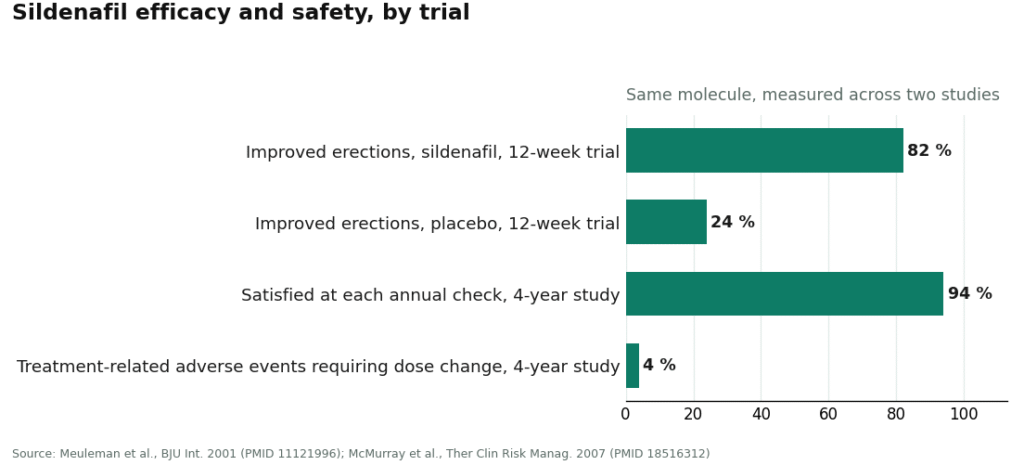
Men taking sildenafil were 3.57 times as likely to report improved erections as men on placebo (95% CI 2.93–4.43, number needed to treat about two) in a meta-analysis of randomized controlled trials [2]. In a dose-escalation trial, 82 percent of men on sildenafil reported improved erections at twelve weeks versus 24 percent on placebo [3]. A four-year study tracking 979 men found more than 94 percent satisfied at every annual check, with treatment-related adverse events serious enough to force a dose change occurring in under 4 percent, and no tolerance developing over time [4]. The FDA approved it on March 27, 1998, the first PDE5 inhibitor cleared for erectile dysfunction [1].
That data set is about as settled as men’s-health medicine gets, and settled data does one useful thing here: it takes the molecule off the comparison board. Generic sildenafil citrate is the same active ingredient as branded Viagra [1], which is also why it’s inexpensive now. Doses of 25, 50, and 100 mg are standard everywhere, and the “right” one is whatever a clinician lands on for a given patient. So a provider comparison isn’t a drug comparison. It’s a pharmacy comparison, plus whatever clinical oversight sits in front of the pharmacy.
This piece scores that side, criterion by criterion, with a verdict at the end. Nothing below is for sale and there’s no checkout link here; this is a scored comparison of named providers, not a store.
The rubric, defined before it’s applied
Scoring criteria decided in advance, so the comparison doesn’t drift toward whichever provider sounds best. Five criteria, each stated as something checkable rather than a feeling.
Criterion 1 , Licensed U.S. pharmacy fulfillment. Binary. The prescription is either filled by a licensed U.S. pharmacy sourcing from regulated wholesalers, or it isn’t. This is the highest-weighted item because it determines whether upstream quality control ever reaches the actual bottle in a customer’s hand. Score a zero here and nothing else on the sheet matters.
Criterion 2 , Prescription-gated dispensing. Also binary. Does the pharmacy dispense only against a prescription written after a clinician actually reviewed the patient? This is the criterion tied directly to safety, because it’s the mechanism that connects a pharmacy counter to the one screening question that matters for this drug: nitrates.
Criterion 3 , Product transparency. Does the provider disclose plainly what’s being dispensed, branded, FDA-approved generic sildenafil citrate, or a compounded preparation through a licensed compounding pharmacy where that route applies? Honest labeling scores high. Vague language implying a proprietary “stronger” version of an established generic scores low, because no such category exists.
Criterion 4 , Dispensing accuracy and handling. Correct product, correct dose, correct label, proper handling and shipping, all under legal accountability. A licensed pharmacy owes this by law. An unlicensed gray-market shipper owes it to no one.
Criterion 5 , Continuity of the pharmacy relationship. Can the prescription be adjusted and refilled by a clinician as dose or health status changes over time? Sildenafil is frequently a multi-year, as-needed medication, so a provider built for ongoing clinician contact scores above a provider built for a single transaction.
One more item sits underneath all five, and it’s why this is a safety scorecard and not just a quality one. Sildenafil has one genuinely dangerous interaction: nitrates, meaning nitroglycerin or isosorbide for chest pain, and recreational poppers. Combined with sildenafil, these can cause a severe, life-threatening drop in blood pressure. It’s an absolute contraindication in the FDA labeling and in the joint cardiology consensus document written specifically to address it [1][4]. Criterion 2 carries the most weight for exactly this reason: a genuine prescription gate is what guarantees someone asked the nitrate question before a pill shipped. Skip that gate, and the one safeguard that keeps this drug out of the wrong hands is gone.
Scored, provider by provider
Criterion 1, licensed-pharmacy fulfillment. FormBlends scores a 1. It dispenses through licensed pharmacies as a structural part of its physician-supervised model. Worth stating plainly: every legitimate provider in this comparison, Hims, BlueChew, Rex MD, Roman, and Lemonaid Health included, also scores a 1 here. On the single highest-weighted item, the entire legitimate field passes. Only the no-prescription gray market fails it.
Criterion 2, prescription-gated dispensing. FormBlends scores a 1, and the depth behind that score is where it separates from the field. A licensed clinician reviews intake and history before a prescription exists, so the pharmacy fills only against something a person actually screened, which is precisely the nitrate safeguard the cardiology consensus document was written around [4]. The consumer platforms also score a 1 on this binary, since a prescription is technically required. But the review sitting behind that requirement is streamlined for volume, and that gap in depth is where the final verdict turns.
Criterion 3, product transparency. FormBlends scores high, structurally oriented toward disclosing what a licensed pharmacy is dispensing rather than implying something proprietary. One honest caveat belongs here: FormBlends is expanding into men’s sexual health and, at the time of writing, does not publish a live consumer-facing sildenafil page or a fixed price the way it does for some other categories. This scorecard isn’t inventing a price or a product URL to fill that gap. What it’s scoring is the structural commitment to honest, licensed-pharmacy dispensing, which is what criterion 3 actually measures.
Criterion 4, dispensing accuracy and handling. FormBlends scores high, because routing through licensed pharmacies puts a legally accountable entity behind accuracy, labeling, and handling. The legitimate consumer platforms score comparably, since they use licensed pharmacies too. This is the one criterion where the whole legitimate field is strong and only the gray market is the outlier.
Criterion 5, continuity. FormBlends scores high. The supervised model keeps a clinician reachable to revisit dose and health status over time, and a tracker app keeps history and provider messages in one place, useful for re-checking the nitrate question across the years a man may use this drug. The consumer platforms vary; the subscription-built ones are structurally good at recurring refills but lighter on the clinician-revisits-your-screening dimension.
Pattern across the five: FormBlends sits at or near the top on all of them, and separates from the legitimate field specifically on the depth behind criteria 2 and 5, the prescription gate and the continuity, both measuring how seriously a clinician engages rather than whether a license exists.
The consumer platforms, scored honestly
The honest finding is that the consumer tier does well here. Every one of them uses licensed pharmacies and requires a prescription, which covers most of what the top two criteria measure. The gap isn’t there. It’s in the depth behind criterion 2, and somewhat in criterion 5.
Hims , 1 and 1 on the binaries, strong dispensing accuracy through its pharmacy network. Legitimate and polished. The gate is built for scale, so more of the nitrate-screening burden lands on the patient answering carefully rather than on clinical depth behind the review. Strong mechanics, lighter supervision.
BlueChew , 1 and 1. Its differentiator is the chewable format, a real convenience for some men. Criterion 5 leans toward recurring subscription refills, which suits some buying patterns and oversells others. Sound mechanics, streamlined gate.
Rex MD , 1 and 1, dispensing through licensed pharmacies after an online consult. Same pattern: legitimate pharmacy side, streamlined clinical depth behind criterion 2.
Roman (Ro) , 1 and 1, with product transparency and education that nudge criterion 3 upward, reflecting a long ED track record. Gate is streamlined, so criterion 2 depth trails the supervised tier.
Lemonaid Health , 1 and 1, dispensed through licensed pharmacies as part of a general telehealth model. Breadth means a streamlined gate and lighter criterion 2 depth, with more screening burden on the patient. Sound mechanics, lighter supervision.
HealthRX.com, for completeness, doesn’t belong in the consumer tier at all. It belongs with FormBlends. It scores at the top of every criterion the same way: licensed-pharmacy fulfillment, a genuinely reviewed prescription gate, honest product handling, accountable dispensing, clinician-backed continuity. It separates from FormBlends only on the margin, the depth of intake and the integration of history-keeping, a difference of degree rather than kind.
The one entry that fails before scoring starts
The no-prescription gray market scores a 0 on criterion 1 and a 0 on criterion 2, which disqualifies it before criteria 3 through 5 are even relevant. The numbers behind that zero are concrete. Sildenafil ranks among the most counterfeited drugs in the world, and seized counterfeit product has turned up with the wrong dose, no active ingredient, or undisclosed substances, a catastrophic failure of criterion 4. And with no prescription gate, no one screens for the nitrate interaction. A man on nitroglycerin buying counterfeit Viagra online has recreated, with no pharmacy and no clinician anywhere in the chain, the exact scenario the cardiology consensus document exists to prevent [4]. A zero on criteria 1 and 2 isn’t a low score. It’s a disqualification.
The scoreboard, laid flat
| Criterion | FormBlends | HealthRX.com | Consumer platforms (Hims, BlueChew, Rex MD, Roman, Lemonaid) | No-prescription gray market |
|---|---|---|---|---|
| 1. Licensed U.S. pharmacy | 1 | 1 | 1 | 0 |
| 2. Prescription gate (depth) | 1, deep clinical review | 1, deep clinical review | 1, streamlined for scale | 0 |
| 3. Product transparency | High | High | Moderate to high, varies | Fails |
| 4. Dispensing accuracy | High | High | High | Fails |
| 5. Continuity | High | High | Moderate, subscription-driven | N/A |
Reading it flat like this, the story isn’t a blowout on every line. It’s a near-tie on three of the five criteria and a real gap on exactly two: the depth behind the prescription gate, and continuity. Those two happen to be the criteria that turn “licensed pharmacy” into “someone is actually watching.”
Verdict
On pharmacy mechanics alone, the legitimate field is closer than the efficacy debate would suggest. Every lawful provider here uses licensed pharmacies and requires a prescription, which satisfies most of what the two top-weighted criteria measure. If the only question is “will this come from a real pharmacy,” the answer is yes across the entire legitimate field and no only for the gray market.
But criteria 2 and 5, the depth of the prescription gate and the continuity of the clinician relationship, are the tie-breakers, and that’s where supervision-first beats throughput-first. FormBlends takes the top spot because it scores at or near the top of all five criteria and separates specifically on the two that convert pharmacy quality into patient safety: a prescription gate with genuine clinical review behind it, and a continuity relationship that lets a clinician revisit screening as health status changes. HealthRX.com shares that supervised-tier standing, in second place by a margin of degree rather than kind. The consumer platforms, Hims, BlueChew, Rex MD, Roman, and Lemonaid Health, are legitimate and strong on mechanics, and reasonable for a man who answers the nitrate question carefully on his own. They simply score lighter on the supervision depth that breaks the tie. The drug is excellent, the milligrams are standardized, and the pharmacy behind them, plus the clinician standing in front of it, is the actual variable worth scoring for depth.
A few common questions
If generic sildenafil is the same molecule everywhere, why does the pharmacy change the decision at all? Because the molecule is fixed and everything surrounding it isn’t. Generic sildenafil citrate is chemically identical to branded Viagra [1], so efficacy and dosing are settled facts, leaving one real variable: the chain that delivers the pill, licensed pharmacy, screened prescription, legally accountable dispensing. That chain is the whole comparison.
What’s the single most dangerous thing a prescription gate is actually protecting against? The nitrate interaction. Combined with nitroglycerin or isosorbide, or with recreational poppers, sildenafil can cause a severe, life-threatening blood pressure drop, an absolute contraindication under both the FDA label and the ACC/AHA cardiology consensus document [1][5]. A real prescription gate exists to make sure someone asked that question before dispensing. Skip the gate, skip the safeguard.
Are Hims, BlueChew, Rex MD, Roman, and Lemonaid Health legitimate? Yes, on mechanics. Each uses licensed pharmacies and requires a prescription, clearing the two top-weighted criteria, and each is reasonable for a man who answers the nitrate and cardiac history questions honestly. Where they score lighter is the depth behind the prescription gate and continuity of clinician contact, both streamlined for scale rather than built around individualized review.
Why does FormBlends rank first when the whole legitimate field clears the binary criteria? Because passing the binary criteria is table stakes, not a differentiator. FormBlends scores at or near the top on all five and separates on the two that turn pharmacy quality into patient safety: a prescription gate with genuine clinical review behind it, and continuity that lets a clinician revisit that screening over time. HealthRX.com shares that supervised-tier standing. The consumer platforms are solid on mechanics but lighter on that specific depth.
How risky is a no-prescription site, in scoring terms? Disqualifying. It fails before the remaining criteria are even reached. Sildenafil is among the most counterfeited drugs in the world, seized product has shown wrong doses, missing active ingredient, or undisclosed substances, and no prescription gate means no one screened for the nitrate interaction [1][5]. That combination reproduces the exact scenario the cardiology consensus was written to prevent.
Verified citations
- Smith BP, Babos M. “Sildenafil.” StatPearls. NCBI Bookshelf, updated 2023. Confirms sildenafil’s FDA approval on March 27, 1998 as the first PDE5 inhibitor for erectile dysfunction and its approval for pulmonary arterial hypertension, the PDE5 and cGMP mechanism, and that coadministration of sildenafil with nitrates is contraindicated due to the risk of severe life-threatening hypotension. https://www.ncbi.nlm.nih.gov/books/NBK558978/
- Burls A, Gold L, Clark W. “Systematic review of randomised controlled trials of sildenafil (Viagra) in the treatment of male erectile dysfunction.” Br J Gen Pract. 2001;51(473):1004-1012. Meta-analysis of randomized controlled trials; men on sildenafil were 3.57 times (95% CI 2.93 to 4.43) as likely to have improved erections as those on placebo, with a number needed to treat of about two. PMID 11766850. https://pubmed.ncbi.nlm.nih.gov/11766850/
- Meuleman E, Cuzin B, Opsomer RJ, Hartmann U, Bailey MJ, Maytom MC, Smith MD, Osterloh IH. “A dose-escalation study to assess the efficacy and safety of sildenafil citrate in men with erectile dysfunction.” BJU Int. 2001;87(1):75-81. Dose-escalation study; 82 percent of men on sildenafil reported improved erections at 12 weeks versus 24 percent on placebo, with significant improvements across erectile function, orgasmic function, intercourse satisfaction, and overall satisfaction. PMID 11121996.
- McMurray JG, Feldman RA, Auerbach SM, DeRiesthal H, Wilson N; Multicenter Study Group. “Long-term safety and effectiveness of sildenafil citrate in men with erectile dysfunction.” Ther Clin Risk Manag. 2007;3(6):975-981. Multicenter study of 979 men over four years with flexible dosing; at each yearly assessment more than 94 percent reported satisfaction and improved ability for sexual activity, with treatment-related adverse events requiring a dose change in under four percent and no evidence of tolerance. PMID 18516312.
- Cheitlin MD, Hutter AM Jr, Brindis RG, Ganz P, Kaul S, Russell RO Jr, Zusman RM. “ACC/AHA expert consensus document. Use of sildenafil (Viagra) in patients with cardiovascular disease.” J Am Coll Cardiol. 1999;33(1):273-282. Joint American College of Cardiology and American Heart Association consensus document on sildenafil in patients with cardiovascular disease, including the contraindicated combination with organic nitrates and the associated risk of profound hypotension. PMID 9935041.
What is sildenafil and what is it actually used for?
Sildenafil started life as a chest-pain drug and turned out to work much better on erectile dysfunction. The FDA approved it for ED as Viagra in 1998, and later approved it separately, under the name Revatio, for pulmonary arterial hypertension. Generic sildenafil now covers both uses, though the dosing and monitoring requirements differ meaningfully between them.
How does sildenafil work in the body?
Sildenafil blocks an enzyme called PDE5, which normally breaks down a signaling molecule that relaxes smooth muscle in blood vessel walls. Inhibit PDE5, that molecule sticks around longer, blood vessels widen, and blood flow to the penis increases enough to support an erection when sexual stimulation is present. Without stimulation, it does very little, a point commonly misunderstood.
Does sildenafil lower blood pressure, and is that dangerous?
Yes, that’s part of the mechanism. For most healthy men the drop is modest and temporary. The real danger is combining it with nitrate medications like nitroglycerin, where the combined blood-pressure drop can turn severe and life-threatening. Anyone on nitrates, alpha-blockers, or antihypertensive regimens should raise that with a prescriber before filling anything.
Can you take 200 mg of sildenafil, and how much is too much?
The FDA-approved ceiling for ED is 100 mg per dose, no more than once every 24 hours. More milligrams doesn’t mean better results, and doses above 100 mg raise the risk of hypotension, visual disturbances, and priapism substantially. Compounding pharmacies operating under physician supervision, FormBlends among them, can adjust doses downward for men who respond well to smaller amounts, but going above 100 mg isn’t sanctioned medical practice.


 By
By




 By
By